9L2O | pdb_00009l2o

Cryo-EM structure and rational engineering of a novel efficient ochratoxin A-detoxifying amidohydrolase


Experimental Data Snapshot

  • Method: ELECTRON MICROSCOPY
  • Resolution: 2.86 Å
  • Aggregation State: PARTICLE 
  • Reconstruction Method: SINGLE PARTICLE 

wwPDB Validation 3D Report Full Report

Validation slider image for 9L2O

This is version 1.0 of the entry. See complete history

Literature

Structure-guided protein engineering and immobilization of an amidohydrolase for efficient ochratoxin A detoxification.

Hu, Y.Xu, Y.He, B.Niu, D.Yang, X.Huang, J.Xie, Z.Shen, P.Li, X.Bai, M.Liu, Z.Li, H.Yang, Y.Huang, J.W.Chen, C.C.Guo, R.T.Dai, L.

(2026) Int J Biol Macromol 358: 151671-151671

  • DOI: https://doi.org/10.1016/j.ijbiomac.2026.151671
  • Primary Citation Related Structures: 
    9L2O, 9L2T, 9L6P

  • PubMed Abstract: 

    Ochratoxin A (OTA) is a pervasive and significant mycotoxin that poses serious health risks to humans and animals. The development of efficient biocatalysts for the enzymatic detoxification of OTA is of great importance. In this study, we enhanced the OTA-degrading activity of three amidohydrolases (ADHs) by up to ninefold. This improvement was achieved by reducing steric hindrance in the binding pocket and fine-tuning the hydrophilic interactions between the enzyme and substrate. The most efficient variant, PwADH/DM, was immobilized onto magnetic Fe 3 O 4 nanoparticles functionalized by the co-deposition of dopamine and polyethyleneimine. Under optimal conditions, this immobilization process achieved a high immobilization efficiency (85.4%) and activity recovery (76.9%). The immobilized enzyme exhibited enhanced pH stability and thermostability, along with good storage stability, reusability, and recyclability. More importantly, the immobilized enzyme completely degraded 100 ng/mL OTA in contaminated milk without affecting the milk's properties. These findings expand our understanding of the molecular mechanisms governing substrate binding and catalysis in OTA-degrading ADHs. Furthermore, they provide a blueprint for enzyme-based OTA decontamination during food processing.


  • Organizational Affiliation
    • State Key Laboratory of Biocatalysis and Enzyme Engineering, Hubei Hongshan Laboratory, Hubei Key Laboratory of Industrial Biotechnology, School of Life Sciences, Hubei University, Wuhan, 430062, PR China.

Macromolecule Content 

  • Total Structure Weight: 352.13 kDa 
  • Atom Count: 24,224 
  • Modeled Residue Count: 3,192 
  • Deposited Residue Count: 3,264 
  • Unique protein chains: 1

Macromolecules

Find similar proteins by:|  3D Structure
Entity ID: 1
MoleculeChains  Sequence LengthOrganismDetailsImage
Imidazolonepropionase408Pseudoxanthomonas wuyuanensisMutation(s): 2 
Gene Names: SAMN06296416_10433
UniProt
Find proteins for A0A286D6Z1 (Pseudoxanthomonas wuyuanensis)
Explore A0A286D6Z1 
Go to UniProtKB:  A0A286D6Z1
Entity Groups
Sequence Clusters30% Identity50% Identity70% Identity90% Identity95% Identity100% Identity
UniProt GroupA0A286D6Z1
Sequence Annotations
Expand
Reference Sequence

Small Molecules

Ligands 2 Unique
IDChains Name / Formula / InChI Key2D Diagram3D Interactions
97U

Query on 97U


Download:Ideal Coordinates CCD File
CA [auth G]
FA [auth H]
K [auth B]
N [auth A]
Q [auth C]
CA [auth G],
FA [auth H],
K [auth B],
N [auth A],
Q [auth C],
T [auth D],
W [auth E],
Z [auth F]
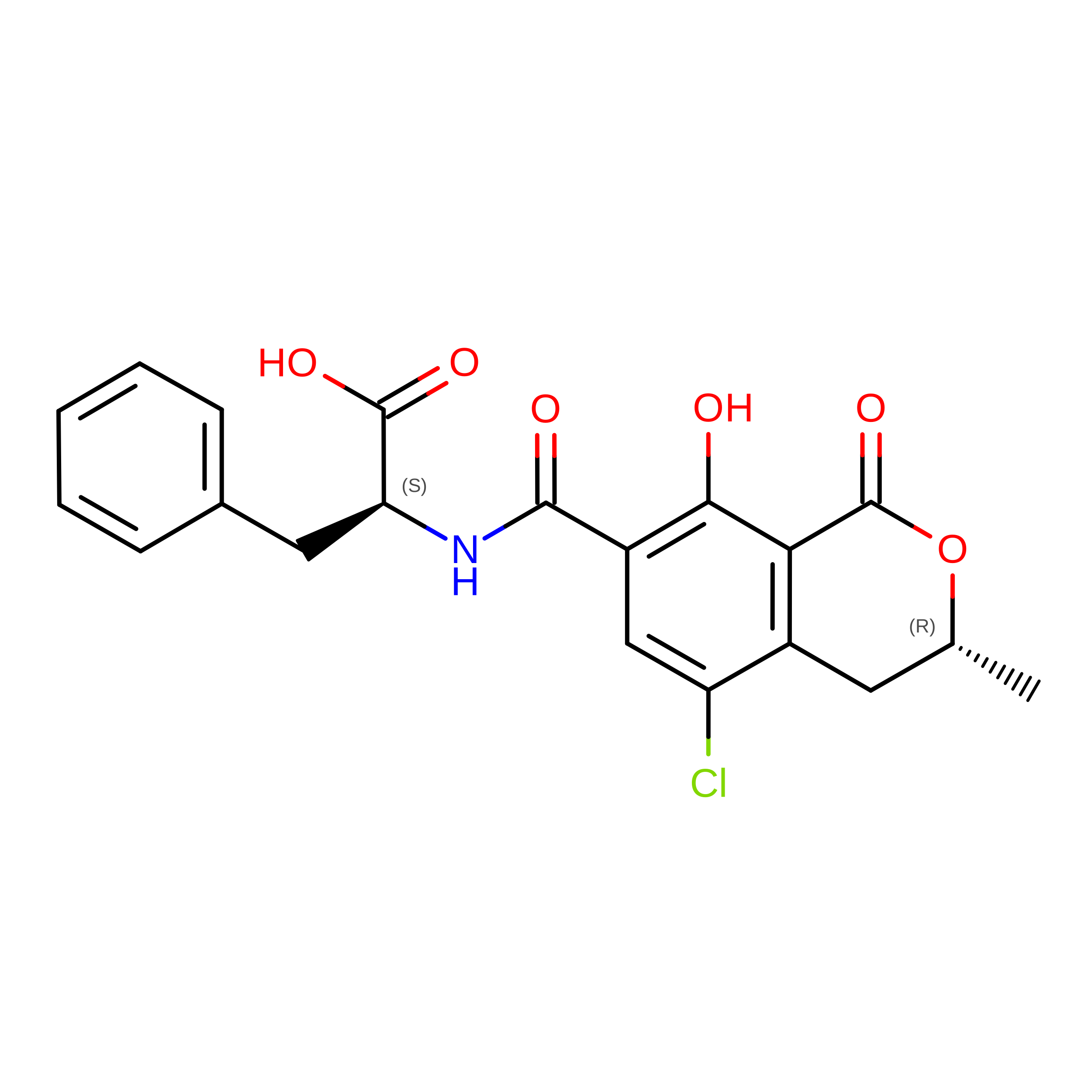
(2~{S})-2-[[(3~{R})-5-chloranyl-3-methyl-8-oxidanyl-1-oxidanylidene-3,4-dihydroisochromen-7-yl]carbonylamino]-3-phenyl-propanoic acid
C20 H18 Cl N O6
RWQKHEORZBHNRI-BMIGLBTASA-N
ZN

Query on ZN


Download:Ideal Coordinates CCD File
AA [auth G]
BA [auth G]
DA [auth H]
EA [auth H]
I [auth B]
AA [auth G],
BA [auth G],
DA [auth H],
EA [auth H],
I [auth B],
J [auth B],
L [auth A],
M [auth A],
O [auth C],
P [auth C],
R [auth D],
S [auth D],
U [auth E],
V [auth E],
X [auth F],
Y [auth F]
ZINC ION
Zn
PTFCDOFLOPIGGS-UHFFFAOYSA-N
Modified Residues  1 Unique
IDChains TypeFormula2D DiagramParent
KCX
Query on KCX
A [auth B]
B [auth A]
C
D
E
A [auth B],
B [auth A],
C,
D,
E,
F,
G,
H
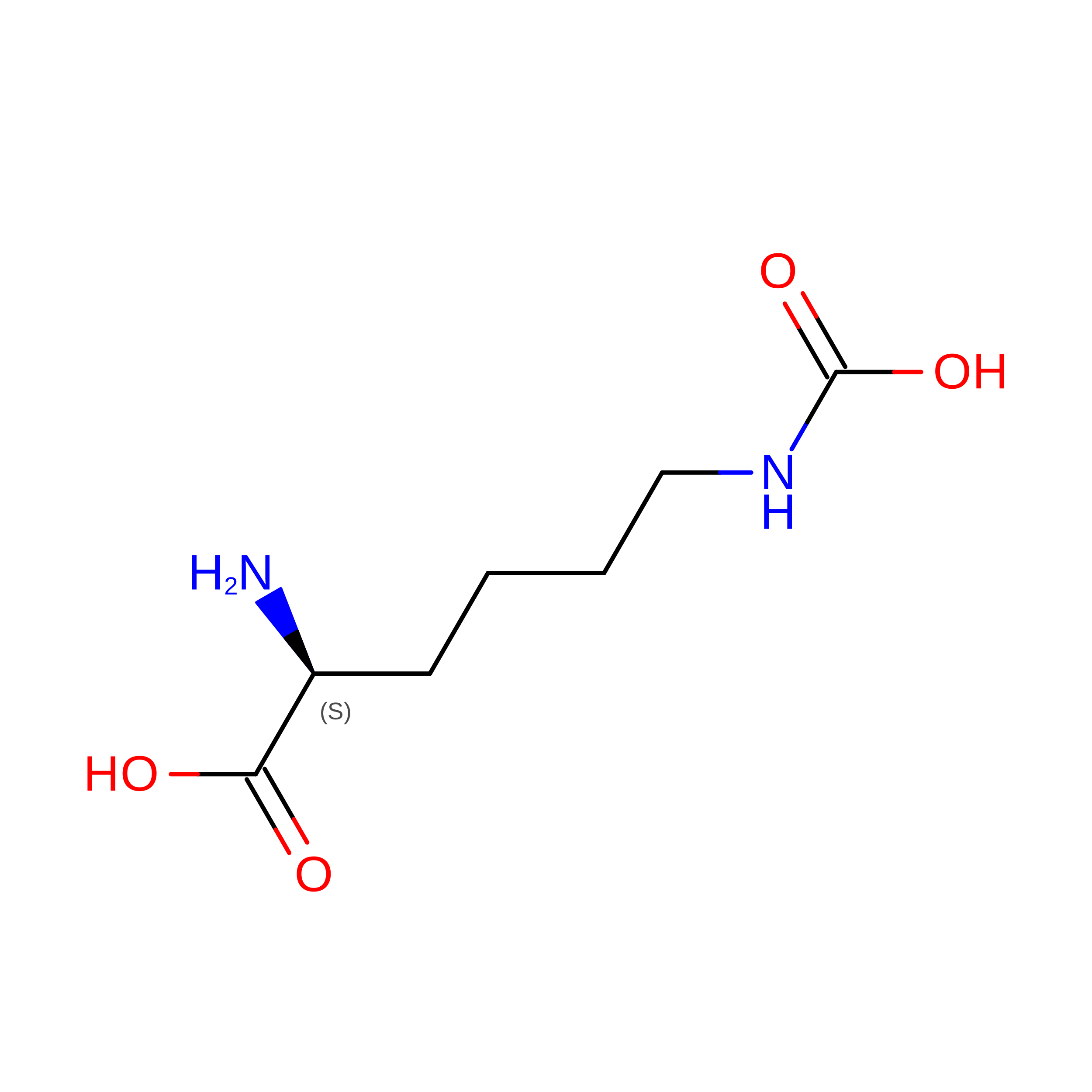
L-PEPTIDE LINKINGC7 H14 N2 O4LYS

Experimental Data & Validation

Experimental Data

  • Method: ELECTRON MICROSCOPY
  • Resolution: 2.86 Å
  • Aggregation State: PARTICLE 
  • Reconstruction Method: SINGLE PARTICLE 

Structure Validation

View Full Validation Report


Entry History 

& Funding Information

Deposition Data


Funding OrganizationLocationGrant Number
Other government--

Revision History  (Full details and data files)

  • Version 1.0: 2026-05-06
    Type: Initial release